Connect this guide with the rest of your visit in the Kuala Lumpur trip planner. Read how the research is made and what its sources establish.
At a glance
Start here
- Separate the flag ceremony at the square from the proclamation at the stadium.
- Use Bangunan Sultan Abdul Samad to understand the colonial administrative setting.
- Use Muzium Negara for the longer national chronology.
- Read Masjid Negara as a post-independence commemorative project.
01
Separate the square from the stadium
The first task is geographical precision. Official Merdeka Square and Bangunan Sultan Abdul Samad accounts place the lowering of the Union Jack and raising of the Federation of Malaya flag at the field on the eve of 31 August 1957. Stadium Merdeka is associated with the proclamation that followed. Both places belong to public memory, but they are not interchangeable stages. Visit the square to understand the transition in the colonial civic centre, then study the stadium precinct to understand the mass national ceremony. Keeping the events separate makes the route clearer and honours the specific historical work each place performs.
- Merdeka Square: the independence-eve flag transition.
- Stadium Merdeka: the independence proclamation gathering.
- Confirm current access to each precinct through its operator.
02
Read the colonial administrative backdrop
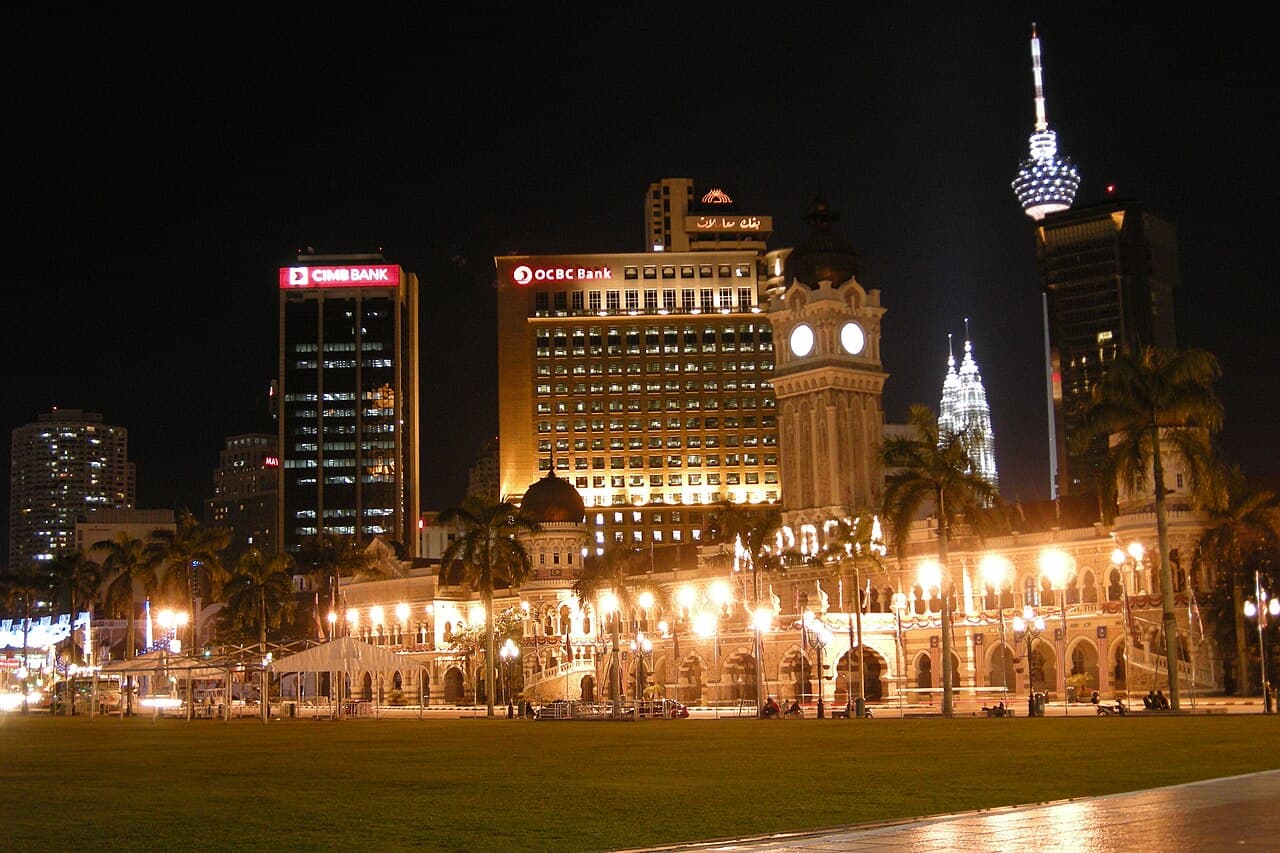
Bangunan Sultan Abdul Samad gives the square its institutional edge. The official complex history says the building was completed in 1897 as the New Government Offices and housed departments central to colonial administration. Its Mughal, Moorish and Gothic-influenced architecture was designed to project authority while responding symbolically to the Muslim ruler of Selangor. That history changes the meaning of the 1957 flag ceremony in front of it: a new national emblem appeared within a landscape built to administer empire. Later government, court and cultural uses added further layers, so the building should be read as an institution with several lives, not as decorative scenery.
- Identify the clock tower, arches and copper domes from across the field.
- Connect the facade with the departments once housed behind it.
- Use current gallery interpretation to test the exterior reading.
03
Use the open square to understand public memory
Merdeka Square remains an active civic space rather than a sealed memorial. Its official visitor page connects the field with independence and continuing national events. That ongoing use is important: ceremonies can renew public meaning, but they can also change access on a particular day. Walk the edge and compare the scale of an individual visitor with the space required for a public gathering. Then locate the former flagpole area in relation to Bangunan Sultan Abdul Samad. If an event is scheduled, follow current official notices and revise the route. A closed section does not erase the story; it demonstrates that the square still has a civic function.
- Read the field as event space, not only as lawn.
- Relate the flagpole area to the administrative frontage.
- Check official event notices before expecting unrestricted access.
04
Place Stadium Merdeka inside a changing precinct
PNB identifies Stadium Merdeka as a heritage asset within the Merdeka 118 precinct and states that restoration from 2005 to 2008 returned it to its original 1957 architectural form. The precinct now juxtaposes that restored stadium with Merdeka 118 and new cultural, religious, commercial and landscape elements. This creates a challenging but productive question: how should a city preserve the setting of a national event while continuing to develop? Observe the relationship from authorised public areas, and use the operator's current information for tours, events or interior access. The existence of a restored landmark does not mean every part functions as an open museum.
- Compare the stadium's low form with the new tower and precinct.
- Distinguish heritage custodianship from guaranteed visitor access.
- Check event and access details on the current Merdeka 118 site.
05
Build the longer story at Muzium Negara
The National Museum prevents the landmark route from becoming a collection of isolated symbols. Its permanent sequence covers early history, Malay kingdoms, the colonial era and Malaysia today. The official museum history says the current building was completed in 1963 and opened on 31 August that year, giving the institution its own direct relationship with the national anniversary. Visit the chronological galleries before or after the outdoor landmarks, depending on how much framework you already have. Current exhibitions and notices can modify the experience, so review the museum's site. The central purpose is context: independence belongs inside a much longer historical sequence.
- Follow the permanent galleries chronologically on a first visit.
- Connect the museum's 1963 opening date with its national role.
- Review current exhibition and facility notices before departure.
06
Read Masjid Negara as post-independence commemoration
Malaysia's official mosque directory says Masjid Negara was proposed as an expression of gratitude for independence and was completed in 1965. It also describes contributions to construction from people across racial and religious communities, and a modern local design centred on an open-umbrella roof. These facts place the mosque in the nation-building period after 1957 rather than at the independence ceremony itself. Study how architecture, landscape and institutional purpose convert remembrance into an enduring public and religious building. Any interior visit remains subject to worship and current mosque instructions; an exterior reading is still meaningful when access is limited.
- Place the mosque after 1957 in the historical sequence.
- Look for the roof's open-umbrella concept and climate response.
- Respect its active religious function and current visitor rules.
07
Build a two-part history day
Use the Merdeka civic core for the first part: square, Bangunan Sultan Abdul Samad and current gallery interpretation. Choose only one second cluster. The Stadium Merdeka precinct answers questions about proclamation, preservation and development; Muzium Negara supplies the national chronology; Masjid Negara explores post-independence architectural commemoration. Trying all three after the square risks reducing important places to quick photographs. Check current access, events, museum notices and transit before choosing. A second day can link the remaining sites, while the related skyline and Islamic-design articles provide focused lenses that prevent repetition.
- First cluster: square and restored civic complex.
- Second cluster: stadium, museum or mosque based on your question.
- Verify every mutable access detail on the official page.
Useful answers
Reader questions
Did Malaya's independence ceremony happen at Merdeka Square?
The independence-eve flag transition occurred at the field now called Merdeka Square. The proclamation of independence was made at Stadium Merdeka, so the two sites should not be merged into one event location.
Sources: Kuala Lumpur Tourism Bureau; Bangunan Sultan Abdul Samad; Permodalan Nasional BerhadWhy is Bangunan Sultan Abdul Samad important to the story?
It formed the colonial administrative backdrop to the square and the 1957 flag transition. Its later government, court and cultural roles show how institutions and meanings changed after independence.
Sources: Bangunan Sultan Abdul SamadWhat does Muzium Negara add to an independence route?
Its permanent galleries place colonial rule and independence inside a sequence beginning with early history and Malay kingdoms and continuing into Malaysia today. The building itself opened on 31 August 1963.
Sources: Department of Museums MalaysiaHow is Masjid Negara connected with independence?
The official mosque history describes it as a project expressing gratitude for independence. Completed in 1965, it belongs to the post-independence nation-building story rather than the 1957 ceremonies.
Sources: Jabatan Kemajuan Islam MalaysiaRead the evidence
Sources and further reading
These sources support the relevant sections above. Plans and comparisons are editorial suggestions. Check operators for current arrangements.
- Merdeka Square ↗Kuala Lumpur Tourism Bureau · Research date 14 September 2026
Official account of the square, its civic role and the independence-eve flag ceremony.
- Bangunan Sultan Abdul Samad ↗Bangunan Sultan Abdul Samad · Research date 14 September 2026
Colonial administrative history, architecture, 1957 flag event, later institutional uses and current cultural role.
- Merdeka 118 ↗Permodalan Nasional Berhad · Research date 14 September 2026
Stadium Merdeka's heritage role, 2005–2008 restoration and relationship with the current precinct.
- About Us ↗PNB Merdeka Ventures Sdn Berhad · Research date 14 September 2026
Custodianship of Stadium Merdeka and Stadium Negara and current precinct context.
- National Museum ↗Department of Museums Malaysia · Research date 14 September 2026
Permanent chronological galleries, building completion, 1963 opening and current notices.
- Masjid Negara ↗Jabatan Kemajuan Islam Malaysia · Research date 14 September 2026
Post-independence commemorative purpose, 1965 completion, community contributions and modern local design.