Connect this guide with the rest of your visit in the Kuala Lumpur trip planner. Read how the research is made and what its sources establish.
At a glance
Start here
- Start with function and date before comparing visual motifs.
- Contrast Masjid Jamek's Mughal influences with Masjid Negara's local modernism.
- Use IAMM to widen the comparison beyond Kuala Lumpur.
- Read Petronas geometry as translation, not a mosque imitation.
01
Begin with difference, not a motif hunt
An eight-pointed geometry, a dome or a repeated arch can appear in many contexts, but resemblance alone does not explain a building. Begin each stop with four questions: what is the building for, when was it made, who describes its design, and how do material and climate shape the result? Official accounts immediately separate the examples. Masjid Jamek is an early twentieth-century mosque with Mughal influences; Masjid Negara is a 1965 national mosque designed in a local modern language; IAMM is a late twentieth-century museum; and Petronas is a skyscraper complex whose plan uses Islamic geometric forms.
- Identify function before style.
- Use the institution's own design account where available.
- Compare material, climate and urban setting as well as ornament.
02
Read Masjid Jamek at the river confluence
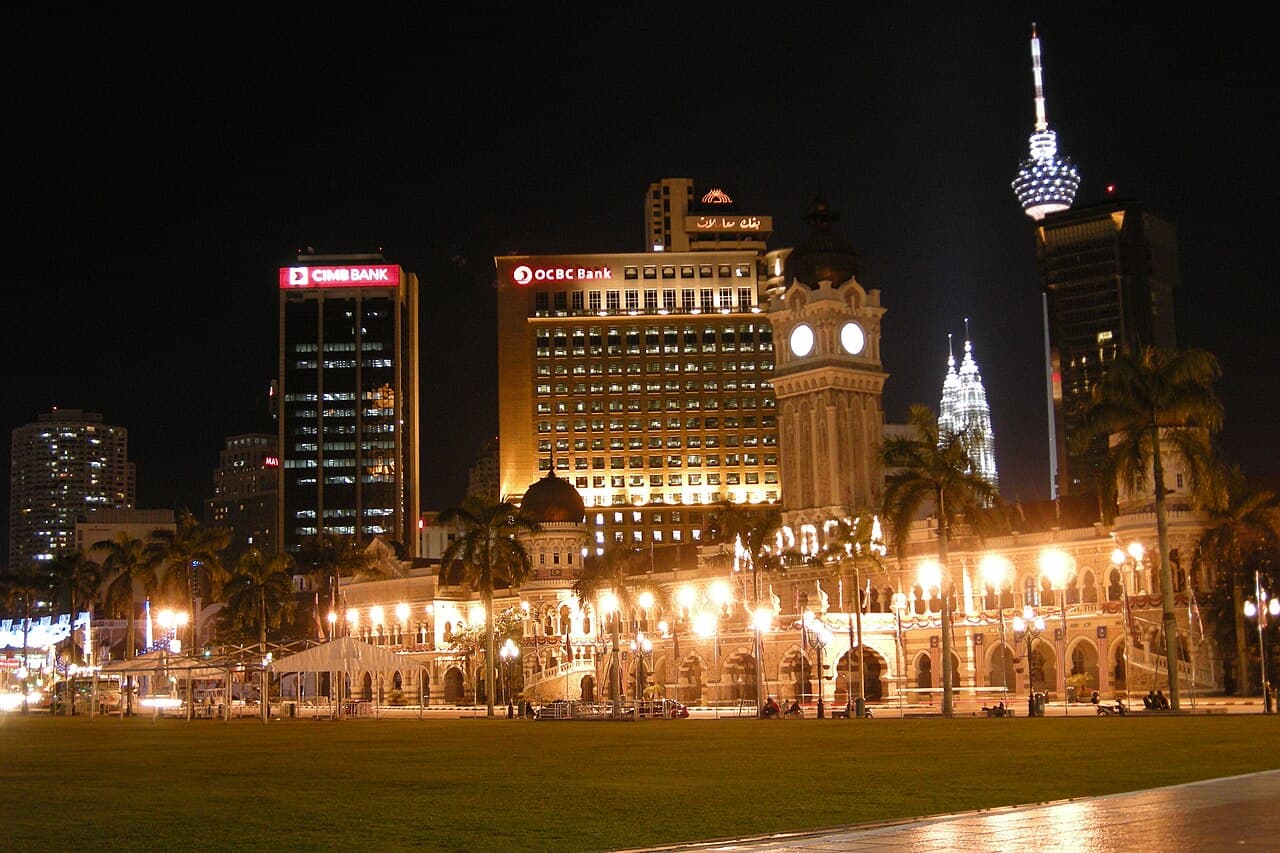
Masjid Jamek's site is part of its architecture. The National Archives places it at the meeting of the Klang and Gombak rivers and records its 1908 foundation stone and 1909 opening. Malaysia's mosque directory describes South Asian or Mughal influence, with a principal dome, smaller domes and minarets, and names A. B. Hubback as architect. Compare those forms with the nearby civic buildings, then notice how riverbanks, bridges and rail now frame the mosque. Because it is active worship space, check current visitor instructions and follow staff direction. Its exterior relationship with the water is already a substantial architectural experience.
- View the mosque in relation to both river channels.
- Compare its domes and minarets with the nearby civic core.
- Use current mosque instructions for any interior visit.
03
See the local modern turn at Masjid Negara
Masjid Negara offers a deliberate contrast. Its official mosque record says designers moved away from the semi-circular and onion-dome conventions of earlier Arab and Mughal-influenced mosques. The building instead applies a local modern approach informed by traditional Malay architecture, climate and social setting. Its open-umbrella roof is the defining form, supported by a wider composition of minaret, courtyards, shade, pools and landscape. Do not reduce this to a claim that the roof merely looks like an object. The design account connects the umbrella concept with national symbolism and with a building intended for a large community after independence.
- Compare roof plane and shade with Masjid Jamek's domes.
- Include gardens, water and circulation in the design reading.
- Respect worship-related access and current mosque guidance.
04
Use IAMM as the comparison room
The Islamic Arts Museum Malaysia gives the city a place to test visual assumptions. Its Architecture Gallery uses models to present major buildings across the Islamic world, beginning with mosques of the Malay World and extending to China, India, Central Asia and elsewhere. The museum stresses adaptation across diverse environments rather than a single universal style. Compare a model with photographs or notes from Masjid Jamek and Masjid Negara. Which elements answer worship, climate or local craft? Which are structural, and which create surface meaning? The gallery can turn two Kuala Lumpur examples into part of a much wider architectural conversation.
- Compare one Kuala Lumpur mosque with a Malay World model.
- Then compare it with a building from another region.
- Separate structural form from surface decoration.
05
Read the museum as an exhibit
IAMM's own building makes the comparison physical. The museum describes a modern structure whose Islamic character comes through details: an iwan-style entrance transformed by Iranian tile workers, roof domes drawing on Central Asian construction traditions, and interior domes made by craftspeople from Uzbekistan. Its collection, however, gives special status to the Malay World, China and India. That combination avoids presenting Islamic art as belonging to one geography. Walk from entrance to interior with attention to scale, tile, colour, curvature and light. The architecture does not reproduce one historical monument; it assembles craft knowledge into a contemporary museum identity.
- Study the tiled entrance before entering.
- Compare exterior turquoise domes with the interior domes.
- Relate the building's mixed craft sources to the collection's geographic range.
06
See geometry translated at Petronas
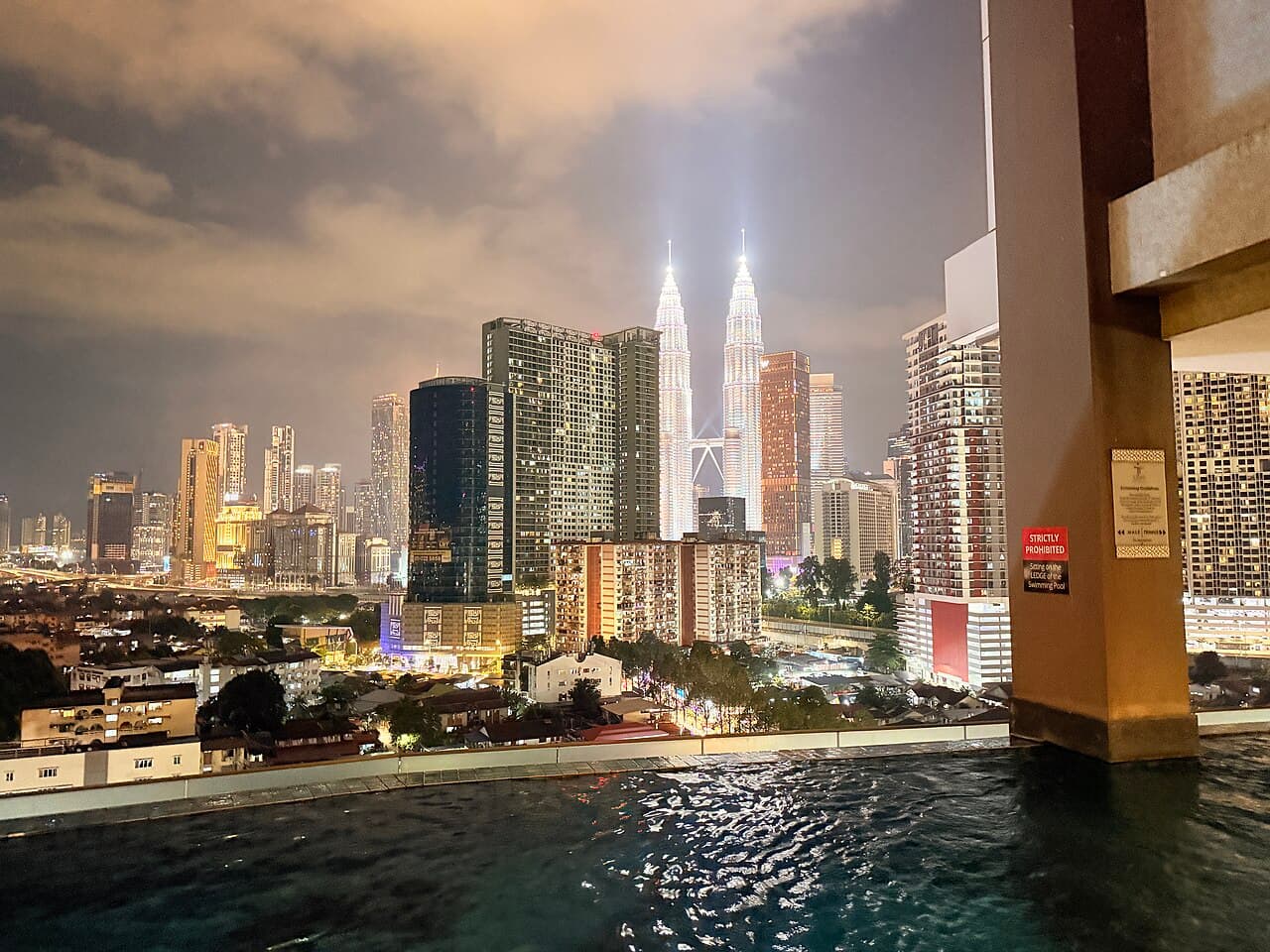
The Petronas Twin Towers show Islamic geometric ideas operating in a non-religious high-rise. The official design page says two interlocking squares form an eight-pointed star in each tower's floor plate, with curved additions creating more usable space. Stainless steel and glass then repeat the geometry across the exterior, while interior motifs refer to Malaysian handicrafts and weaving patterns. The result is not a mosque enlarged into an office tower. It is a modern structural and spatial problem shaped through a selected geometric vocabulary. From KLCC Park, look for repetition, symmetry and the bridge between the pair before considering the ticketed visitor route.
- Connect the plan geometry with the visible curved bays.
- Look for repetition and symmetry before decorative detail.
- Use the official page for current tower access.
07
Build a respectful comparison route
Divide the study into two clusters. Masjid Jamek and the nearby civic core let you compare an active early mosque with Mughal-influenced public architecture. Masjid Negara and IAMM form a second cluster around Perdana, pairing a national mosque with a museum that explains regional variation. Petronas works as a separate modern conclusion at KLCC. Check official pages for current public access, exhibitions and admission, then remove any interior that does not fit the day. Do not photograph worshippers or restricted spaces merely to complete a visual comparison; follow the instructions posted by each site and use public exterior viewpoints when needed.
- Cluster one: Masjid Jamek and the river civic core.
- Cluster two: Masjid Negara and IAMM.
- Modern conclusion: Petronas from KLCC Park or its official visitor route.
Useful answers
Reader questions
Do Kuala Lumpur's major Islamic buildings share one style?
No. Masjid Jamek reflects Mughal influences, Masjid Negara uses a local modern and climate-aware language, IAMM combines several craft traditions, and Petronas translates geometry into a skyscraper plan.
Sources: Jabatan Kemajuan Islam Malaysia; Jabatan Kemajuan Islam Malaysia; Islamic Arts Museum Malaysia; PETRONAS Twin TowersWhat should I look for at Masjid Negara?
Study the open-umbrella roof, minaret, shaded circulation, pools and landscape as one modern composition. Check current visitor access and remember that the building's primary function is worship.
Sources: Jabatan Kemajuan Islam MalaysiaWhich IAMM gallery best supports an architecture study?
The Architecture Gallery is the direct starting point because it compares models from the Malay World and other regions. The museum building itself then adds a contemporary example using tilework and several dome traditions.
Sources: Islamic Arts Museum Malaysia; Islamic Arts Museum MalaysiaAre the Petronas Twin Towers designed like a mosque?
That description is too simple. Their official design begins with interlocking squares and an eight-pointed geometric plan, adapted with curved bays for a modern high-rise's spatial needs.
Sources: PETRONAS Twin TowersRead the evidence
Sources and further reading
These sources support the relevant sections above. Plans and comparisons are editorial suggestions. Check operators for current arrangements.
- Masjid Jamek Sultan Abdul Samad ↗Jabatan Kemajuan Islam Malaysia · Research date 14 September 2026
Active mosque context, architectural influences, domes, minarets and architect.
- Masjid Jamek Kuala Lumpur ↗National Archives of Malaysia · Research date 14 September 2026
Confluence location, 1908 foundation stone, 1909 opening and official architectural record.
- Masjid Negara ↗Jabatan Kemajuan Islam Malaysia · Research date 14 September 2026
1965 completion, local-modern design, move away from onion-dome conventions, umbrella roof and climate response.
- Architecture Gallery ↗Islamic Arts Museum Malaysia · Research date 14 September 2026
Architectural models, Malay World comparison and adaptation of Islamic architecture across regions.
- Islamic Arts Museum Malaysia ↗Islamic Arts Museum Malaysia · Research date 14 September 2026
Permanent galleries, material scope and current museum information.
- About the Museum ↗Islamic Arts Museum Malaysia · Research date 14 September 2026
Museum architecture, Iranian entrance tilework, Central Asian and Uzbek dome craft, and regional collection emphasis.
- Visit Us ↗Islamic Arts Museum Malaysia · Research date 14 September 2026
Official current museum location and visitor-planning information.
- Design and Structure ↗PETRONAS Twin Towers · Research date 14 September 2026
Interlocking-square floor plate, eight-pointed geometry, curved additions, materials and Malaysian craft motifs.
- Admission and Ticketing ↗PETRONAS Twin Towers · Research date 14 September 2026
Official current admission and booking channel.